Methodology
Science-based impact measurement. Open-ended. Comparable. Transparent.
The PI Reference Path™
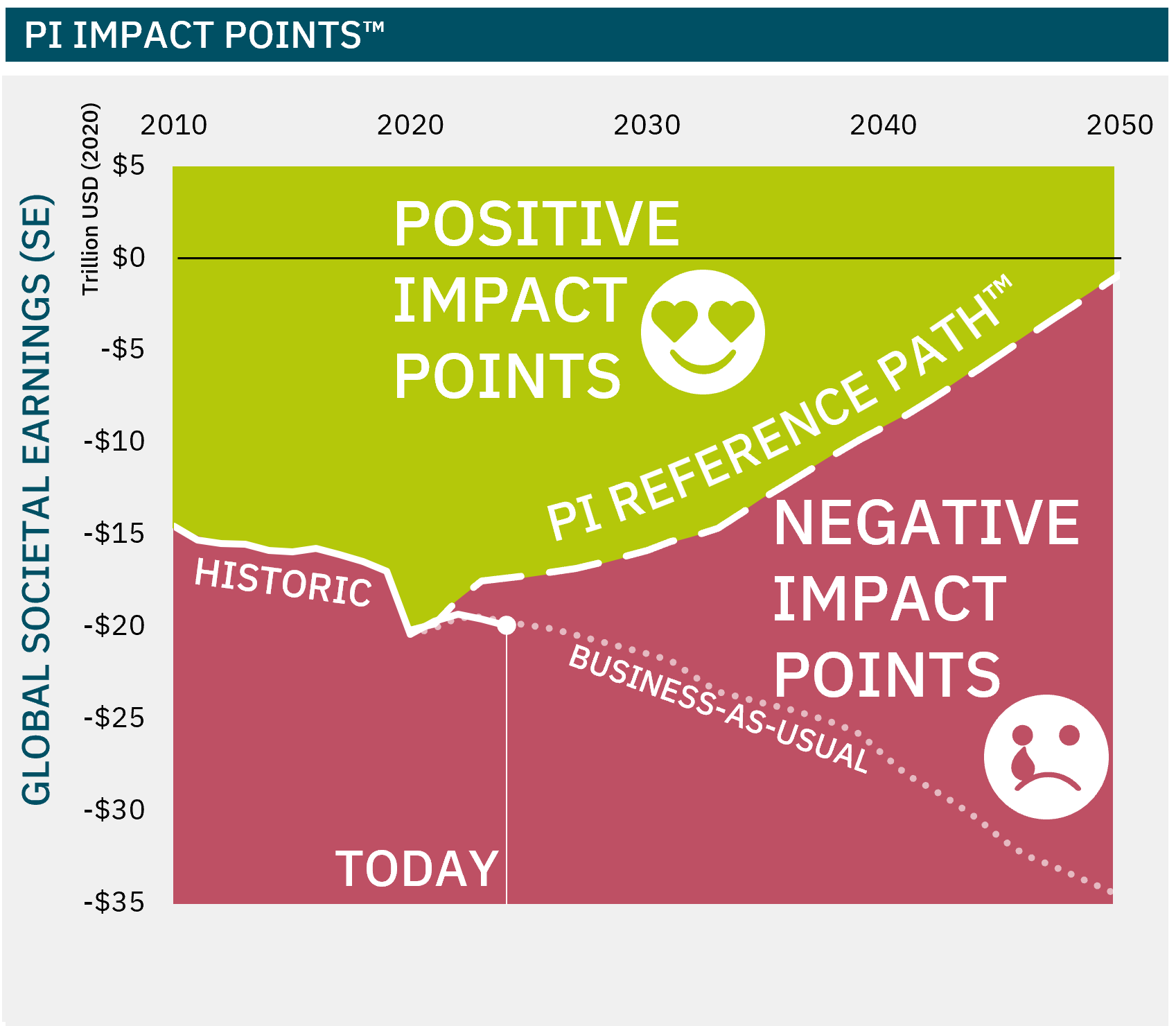
The foundation of Impact Points is the PI Reference Path™ — a science-based trajectory derived from internationally agreed sustainability targets and translated into economic benchmarks.
The PI Reference Path™ defines what economic performance needs to look like in order for global sustainability goals to be met. Impacts are not assessed in isolation. They are evaluated relative to this trajectory: how does the actual performance of a product, company, or investment compare to what the reference path requires at this point in time?
Why relative to a reference path?
Absolute performance figures — tonnes of CO₂, litres of water, hectares of land — are necessary but not sufficient for comparability. The reference path provides a consistent, dynamic benchmark that adjusts over time and across sectors, making it possible to compare performance across products, companies, investments, and time periods on an equal basis.
What is measured
Impact Points assess performance across six material impact categories: climate, water, biodiversity, health, social, and fiscal. Each category is linked to internationally recognised science-based targets and evaluated relative to the PI Reference Path™.
The Path derives its target values and reference data from IPCC, UNEP, UN-SDGs, the Stockholm Resilience Centre, ILO, IMF, OECD, and PI’s own calculations, using 2020 as the baseline year.
From measurement to Impact Points
Translating real-world impacts into a single comparable score requires measuring deviation from the PI Reference Path™ across all impact categories and aggregating those deviations into one performance score.
Reference Path deviation
For each impact category, the actual performance of the economic activity is compared to the PI Reference Path™ at the relevant point in time. The deviation — positive or negative — captures whether performance is moving in the right or wrong direction, and by how much.
Translation into Impact Points
Physical impacts such as emissions or resource use are translated into comparable economic values, which allows impacts across different categories to be combined into a single number. The result is expressed per unit of revenue, per product unit, or per unit of investment — making comparison across any type of economic activity possible.
For the nerds
Impact Points equal the monetised deviation of impacts from the PI Reference Path™, using science-based valuation factors.
Want to learn more?
For a concise introduction to the Impact Points methodology — including the reference path concept and the six impact categories — get in touch directly. We are happy to walk you through the framework in a call.